
Cut Off From The Living
Daniel 9:26 “And after threescore and two weeks shall Messiah be cut off but not for himself: and the people of the prince that shall come shall destroy the city and the sanctuary; and the end thereof (shall be) with a flood, and unto the end of the war desolations are determined.
27 And he shall confirm the covenant with many for one week: and in the midst of the week he shall cause the sacrifice and the oblation to cease.”
Having established the Messiah will appear in 27 AD, we can turn our attention to the last week of the seventy weeks.
Those familiar with the Gospel, the Good News, that Jesus Christ died for the sins of the world, Gabriel telling Daniel the Messiah will be cut off should sound very familiar. So, too, should the language, “he will confirm a covenant with the many,” and “putting an end to sacrifice and the oblation (grain offering)” be familiar narratives.
Verse 27 tells us this covenant will be for one week, or seven. This week is the last week of the seventy weeks. “In the midst of the week,” somewhere around the middle of the week, “he will put an end to sacrifice and the grain offering.”
To the Jewish people of antiquity, their religion and law was centered around offering animals and grain offerings to God as atonement, or a reparation—payment—for their sins. Leviticus chapter four details the relevance of the animals in sin offering.
https://www.bible.com/bible/2692/LEV.4.NASB2020
In addition, The Jewish Passover in the Book of Exodus is central to understanding this prophecy given to Daniel. It is also a core pillar as it relates to Jesus, the Messiah, and all of Christianity, as we will see further.
The Jewish Passover commemorates God’s deliverance of the Israelites from Egyptian slavery in the late second millennium BCE, as described in the Book of Exodus.
https://www.bible.com/bible/2692/EXO.12.NASB2020
It centers on the sacrificial lamb, whose blood marked the homes of the Israelites, sparing them from the judgment and final plague God was to place on Egyptians for what they were doing to the Israelites and for Pharoah not letting the Israelites leave Egypt and go to the land God promised them. God would execute the plague as a judgment by killing the Egyptians’ first-born sons and the first born of their animals. God tells Moses, God’s appointed leader of the Jews, and Aaron, Moses brother and Chief Priest of the Jews, to relay to the Israelites that each household is to take an unblemished lamb and slaughter it at midnight on the fourteenth day of the month of Nisan (The first month in the Jewish Calendar). They are to eat the lamb and put some of the blood of the lamb around the entry doorway of their dwellings. God tells Moses and Aaron that when God sees the blood around the doorway of the dwelling, God will pass over that dwelling and no plague will come upon it. God tells Moses that this day would become a memorial to Israel, and they are to celebrate it every year on the 15th of Nisan.
The Passover Festival is a reminder to the Jewish people that God is faithful and will keep His end of the covenant.
After the sixty-two weeks, The Messiah is to be cut off, but not for himself. That is to say, the Messiah is to be cut off from the living. The Hebrew word is “karath.” It means to cut off or destroy. “But not for himself” seems to mean he will not be killed because of anything that he has done. In other words, he will be innocent. Peter of Jesus in 1 Peter 2:22: “He committed no sin, and no deceit was found in his mouth.”
“And he shall confirm the covenant with many for one week: and in the midst of the week he shall cause the sacrifice and the oblation to cease.” “He” is referring to the Messiah. It doesn’t make sense for “he” to refer to anyone else. Gabriel was talking about the Messiah appearing and then being cut off. It stands to reason Gabriel is going to keep referring to the Messiah, as we will see.
In Luke 22:20 Jesus tells his disciples He is establishing a new covenant. “He took the cup after they had eaten, saying, “This cup, which is poured out for you, is the new covenant in My blood.””
We see it also in Matthew 26:26-28, “Now while they were eating, Jesus took some bread, and after a blessing, He broke it and gave it to the disciples, and said, “Take, eat; this is My body.” 27And when He had taken a cup and given thanks, He gave it to them, saying, “Drink from it, all of you; 28for this is My blood of the covenant, which is being poured out for many for forgiveness of sins.”
Jesus explicitly states in this covenant he is establishing that his blood is being poured out for many for forgiveness of sins. Remember, the entire Jewish Law is predicated on offering blood sacrifice for the forgiveness of sins. Here Jesus is saying his blood is for the forgiveness of sins.
Remember the first Jewish Passover, that an unblemished lamb was slaughtered, and the blood of the lamb was put on the doorway so that God would pass over their houses so as to pass over judgement on them. Any house with the blood of a lamb on the doorway was not judged by God.
John the Baptist, in John 1, starting in verse 29, says, “The next day he saw Jesus coming to him, and said, “Behold, the Lamb of God who takes away the sin of the world!”” Jesus says he makes a new covenant, his blood offered as a sacrifice for sins. Jesus is the unblemished Lamb of God, who sheds his blood for the sins of many. God sees the blood of the lamb and passes over the person that is washed in the blood of the lamb. The Apostle John, in 1 John 3:5 writes: “But you know that he appeared so that he might take away our sins. And in him is no sin.”
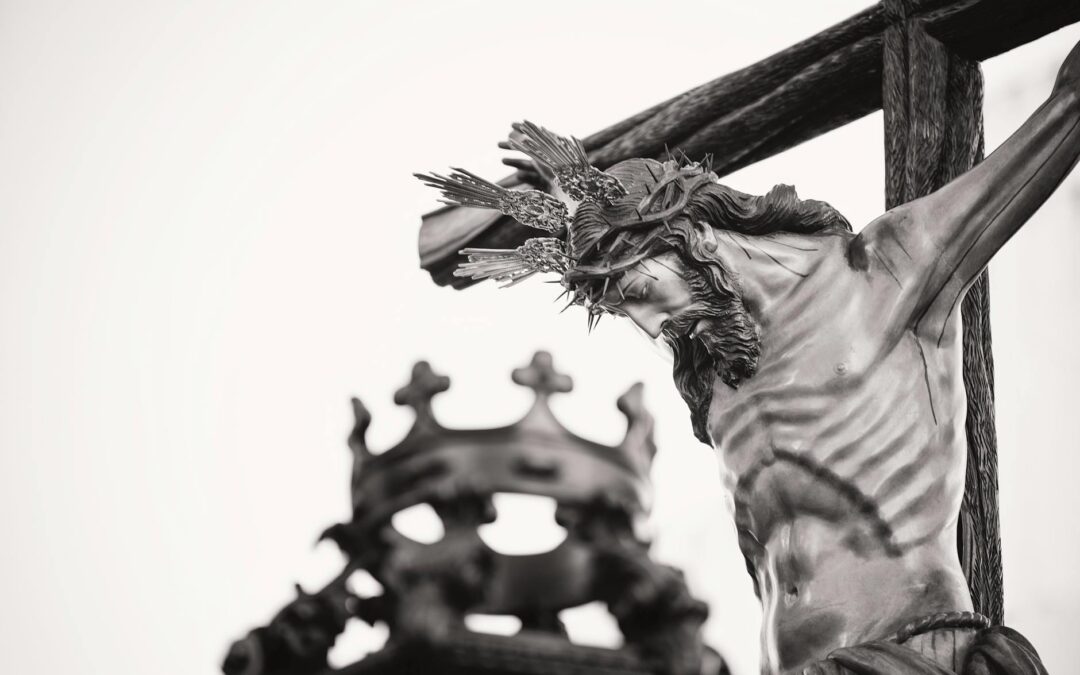
Jesus is crucified, hung on a cross and killed, by decree of the Roman Prefect, Governor of Judea Pontius Pilate. This is at the behest of the Jewish leaders, who charged Jesus with blasphemy for claiming to be God.
It is widely proclaimed by many historians Jesus’ earthy ministry lasted for three and a half years. It is not explicitly stated in the Bible exactly how long it lasted—though, it is plausibly extrapolated from harmonies from the four Gospels. Three and a half years is so commonly held that I will not spend time laying out this time frame.
It is also widely accepted that Jesus was crucified on a Friday and resurrected on a Sunday. The Gospels state Jesus rose on the first day of the week—Sunday. Jesus said he would be raised on the third day after his death. Subtracting three days from Sunday, we land on Friday.
In a study titled, ‘Dating the Crucifixion,’ Colin Humphreys and W.G. Waddington used astronomical calculations in an attempt to determine the date of Jesus’ crucifixion. Their calculations, based on the lunar cycle and the Jewish calendar, indicated that Passover, which falls on the 14th of Nisan, aligned with a Friday on two occasions within the plausible time frame of Jesus’ ministry. In our calendar, the Gregorian Calendar, these two Fridays correlate to April 7th, 30 AD and April 3rd, 33AD. Liviu Mircea and Tiberiu Oproiu, two astronomers from the Astronomic Observatory Institute in Cluj, Romania, came to the same observation regarding the dates.
“And he shall confirm the covenant with many for one week: and in the midst of the week he shall cause the sacrifice and the oblation to cease.” Jesus’ earthly ministry lasted approximately 3.5 years. Jesus confirmed a covenant with many, as described, in the final week of Daniel’s seventy weeks, and in the midst of the week, about 3.5 years, the Messiah is cut off, but not for himself, and causes the sacrifice and oblation to cease. Jesus replaces the sacrifice of the animals and grains with his own sacrifice for sins, establishing a new covenant with mankind. God now passes over the sins of mankind on account of Jesus, replacing the Jewish covenant of animal sacrifices. The sacrifice of animals for sins is no longer accepted by God, causing them to effectively cease.
Daniel 9:25 “Know therefore and understand, that from the going forth of the commandment to restore and rebuild Jerusalem unto Messiah The Prince (shall be) seven weeks, and threescore and two weeks.”
The commandment to restore and rebuild Jerusalem was in 457 BC. Seven sevens plus three score and two sevens equals until Messiah the Prince = 483 years. 457 BC + 483 years = 27AD
Daniel 9:26 “And after threescore and two weeks shall Messiah be cut off but not for himself.” Daniel 9: 27 “And he shall confirm the covenant with many for one week: and in the midst of the week he shall cause the sacrifice and the oblation to cease”
April 7th, 30 AD, approximately 3.5 years, in the “midst” of the week, Messiah is cut off, killed, and causes the sacrifice to cease.
This leaves us with the rest of the last week.